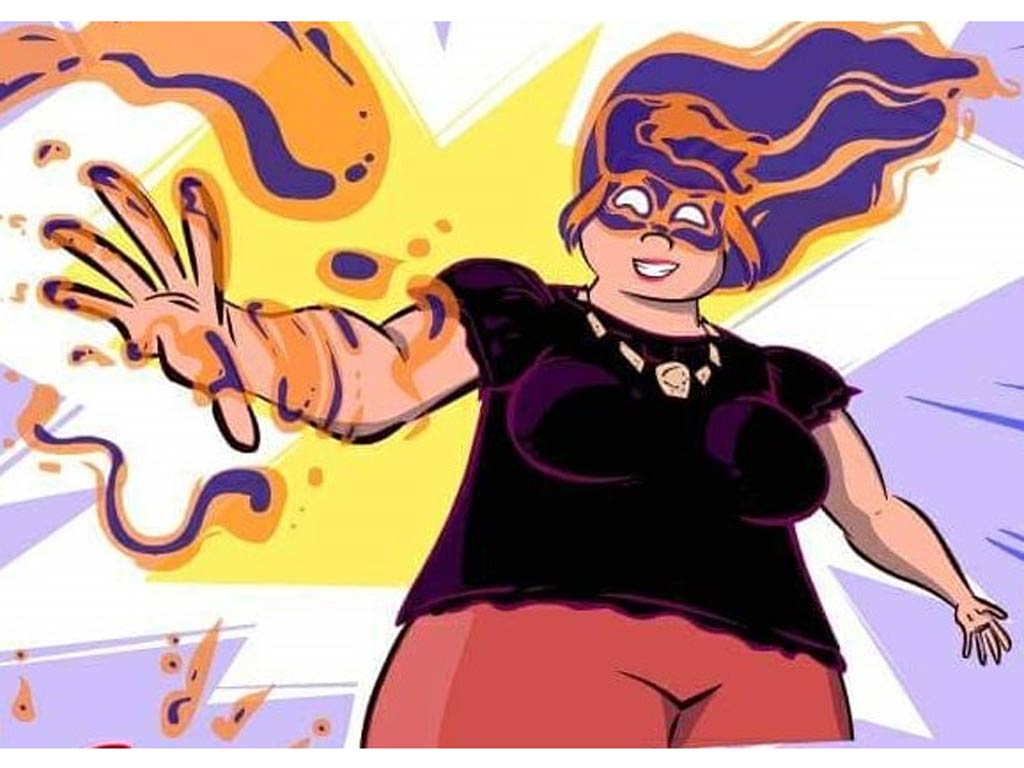
Cuba’s first superhero feature length animation premiered in December 2022 at Havana’s New Latin American Cinema festival. ‘La Super’ translated as ‘Supergal’ features a feminist superheroine based on a comic strip made by director Ernesto Piña with scriptwriter Hugo Rivalta more than a decade ago. “We have created an international story that can be understood anywhere in the world and doesn’t happen in a specific known place. It takes place in a city with an eclectic fusion of culture, architecture or behaviour of the people,” said the filmmaker.
The film’s protagonist is Jevalentina, an aboriginal warrior who five centuries ago freed the inhabitants of a village. Her spirit is reborn 500 years later and is presented to Yudeisi, a young chemistry teacher, whose family worships the iconic warrior. Yudeisi is the one chosen to become a kind of superhero and defend women from patriarchal violence. Piña explains “Jevalentina gives her the power of harmony, which hypnotizes men, clarifies their thoughts and turns them into different beings.”
Before starting the project Piña and Rivalta decided that the social issue they were going to deal with would be sexist violence, something that they themselves felt is a day-to-day problem in their country. “Given the harsh reality, I felt the desire and the need to make it visible in my art. ‘Supergal’ will be my modest contribution to the fight for gender equality, so indispensable in a just society,” the director explained.
The story, with the voices of Ariana Álvarez as Yudeisi and Tahimí Alvariño as Jevalentina, had been developing between Piña and Rivalta since 2009. There was always hope that the cartoon would become a full-length animation but it was not a reality until 2019 when ICAIC, the Cuban Film Institute, took over the project.
The film editor Liliana Hernández was one of several women who played crucial roles in the project. “La Súper’ is the first feature film I edited. The film has a fairly dynamic pace. In addition to the cuts made in the editing process, the way in which the actions were conceived from the script and its staging influenced me,” she said.
The very nature of the subject meant the production faced numerous dilemmas. The most important of all was to show sexist violence with seriousness and respect. Advice was given by specialists such as the professor of Cinema and Gender at the Faculty of Art of Audiovisual Media, Danae Diéguez, as well as a Doctor in Psychological Sciences and feminist researcher, Norma Vasallo. The latter was responsible for revising parts of the plot and also contributed to the development of the script.
This also impacted on the aesthetics of the film. Piña explains that “as it is such a serious theme, a cartoon-type animation was thought to create a distance with the public and, at the same time, draw attention to the colours so that it follows the story they are telling, without any type of didacticism […]. Hopefully it helps to reflect on the different modes of gender violence that exist so that it is understood that it is an evil that we must eradicate.”
After the premier some specialists made assessments with a critical and constructive eye, including psychologist and gender specialist Mareleen Díaz Tenorio who said: “I was very happy with the result. I noticed many positives from my experience in gender. Most importantly, it is focused on important essences. Some might say that the film does not show all expressions of gender-based violence and it is true. But that may be impossible because there are too many variants. But what it could do and did do was focus on gender violence exercised by men against women. And that is the most frequent and most serious expression of all gender-based violence in the history of humanity. Therefore, the film hits the target, it is accurate.”
“Another value that I appreciated was the animation itself and its appeal to prevent violence by educating, changing subjectivities through a way that spontaneously reaches those who prefer or like animation. Art as an alternative for change. This film has a crucial value for me, and that is that violence does not disappear with more violence. ‘Supergal’ does not attack to achieve its objectives. The path is never violence. I noticed the diversity and authenticity of body shapes, as well as the protagonist herself whose body is contrary to the canons of beauty promoted by patriarchy. I imagine the screening of the film with groups of young people and then a debate and group reflection. But in any case, the great thing is that the work speaks and walks by itself. It is a great contribution for us in Cuba, and in other societies too of course, to achieve greater gender equality,“ concluded Díaz Tenorio expressing her respect and admiration to Piña for his work and congratulating the entire production team.
The team also received advice from other filmmakers such as Ernesto Daranas, José Martín Díaz, Jorge Oliver, and Juan Padrón.
ICAIC Animation Director, Esther Hirzel, said: “It’s not just about the production of feature films that are continuing to grow, too, through series; but (we need) to continue insisting on addressing core issues. I think that because our studios have a responsibility to think about the experience not only of children but of the family and society itself, we dared with ‘La Súper’ with this urgent and important issue”.
A shortened version of a Cuba50.org article based on reports in CubaNow.cult.cu and cinelatinoamericano.org


 SCREEN CUBA, 15-28 March 2026, LONDON & BEYOND