
OVER THE last year more than 15,000 children and teenagers have crowded into Cuban cinemas to see animations featuring Elpidio Valdés, restored with the help of funds raised by the Screen Cuba film festival. Elpidio is a cartoon character created for children in the 1970s by Juan Padrón, who symbolises the fight for Cuban independence and is well known throughout Latin America. Another four films about Elpidio are currently being restored with Screen Cuba support, and their restoration is part of a vital broader initiative to preserve Cuba’s film and audiovisual heritage.
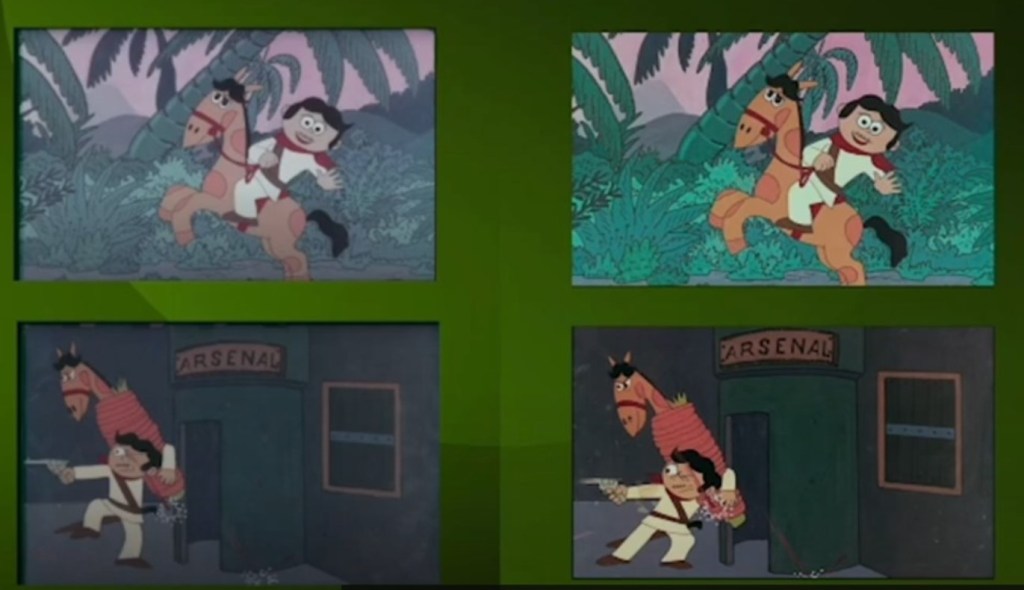
Today it is an urgent priority for the Cuban Film Institute (ICAIC) to rescue deteriorating works from its archive of 60,000 cans of film. Luciano Castillo, the director of Cinemateca de Cuba, ICAIC’s f ilm library, explains the ‘absolute tragedy’ of ICAIC entering the 21st century with a ‘disastrous legacy’ where a large part of the pre-1959 heritage had disappeared, and works created after the Revolution suffered extensive damage. The deterioration was mainly due to Cuba’s tropical humidity, intensified by power shortages which meant that for eleven years during the ‘Special Period’ the archives lacked air conditioning. Today an enormous project is underway to preserve Cuba’s audiovisual heritage, which Sergio Benvenuto Solás, head of the Gibara International Low-Budget Film Festival, rates at “high risk.”
This ambitious venture has immense historical and cultural value. In Cuba, cinema is important not just as entertainment, but as a critical medium for social change, education, and the formation of a national identity. Each restoration will recover traditions and social dynamics for future generations, to reveal their history and help shape their cultural future. “At times even a minute of a movie we think might not have historical value, it really has, so without a doubt, it works as a record and testimony of an age,” says Castillo.
Although Cuba is going through one of its most difficult times since the ‘Special Period’ in the 1990s, the government has managed to provide limited funds for ICAIC. However, the blockade imposed by the US severely impacts Cuba’s ability to carry out restoration work by restricting access to foreign currency, software licences, and the advanced equipment required. Furthermore, film restoration is a highly specialised undertaking that addresses issues such as the film’s physical degradation from age, scratches and tears, deterioration of sound, degradation of colour, inadequate subtitles and other deficiencies. Each stage in restoration needs to be executed by highly skilled teams of specialists that Cuba doesn’t yet have.
To overcome these challenges, Cuba has sought international collaboration with numerous labs throughout the world. Each has its own stories of the challenges and strategies of preserving Cuban films. Italian restorers recount how it took seventy specialists to restore Memories of Underdevelopment (1968). With Lucía (1968), the lab in Bologna was confronted by a variety of photographic treatments, known only to veteran filmmakers in Cuba, used to achieve a very specific look for each of the film’s three sections. Death of a Bureaucrat (1966) presented US technicians with “the worst state of preservation” and “the toughest problems” they had encountered. Nevertheless, each restoration was successful, and there have been other success stories along the way. A major one was the restoration in 2015, after three years of work, of 1,500 documentaries that make up ICAIC’s famous Noticiero/ Newsreel archive, added to the “Memory of the World” register by UNESCO in 2009. In 2024, 75 intact Cuban films, some lost to Cuba itself, were discovered in Moscow’s film vaults. More recently, ICAIC announced that 25 titles are being restored by the prestigious Cinemateca of Bologna in Italy.

While highly valued, collaboration in restoration comes with a price tag, with clauses committing Cuba to share revenues from the screening rights of their films. Even where cine films have not deteriorated, collaboration to digitalise the work is needed – for its future preservation, and to enable screenings in cinemas beyond Cuba. They cannot afford the specialised scanner equipment required to digitalise their own films themselves.
Much remains to be done and ICAIC believes international collaboration is the way ahead. It will give the finest results, and it is also the best way to safeguard a priceless cultural heritage that belongs equally to cinema worldwide.
By Dodie Weppler for CubaSi magazine Autumn 2025


 SCREEN CUBA, 15-28 March 2026, LONDON & BEYOND