MICHAEL CHANAN previews three films of Tomás Alea to be shown in Screen Cuba 2026
Looking back at the films of Tomás (Titón) Gutiérrez Alea almost thirty years after his death, the claim can be made that he occupies a unique position for a deeply political filmmaker in a country of political filmmakers, in the heyday of a movement of political filmmaking across the continent – revolutionary, Marxist, anti-imperialist, and iconoclastic – known as the New Latin American Cinema.
What makes his films stand out is the fact that he can never be accused of political rhetoric, or what Cubans call teque – tediously repeated revolutionary-sounding bombast – except when he’s parodying it. As a result, although the politics of Cuban (and Latin American) cinema have evolved far beyond the heady revolutionary militancy of the 1960s and 70s, Alea remains a touchstone for subsequent generations, whatever their ideological inclinations. When he died in 1996 it was striking that even young filmmakers who didn’t share his political values celebrated his memory.
The three films of his included in this year’s Screen Cuba season are representative of his varied output: a period comedy, a historical drama, and a contemporary love story. They reflect his own perennial themes but in contrasting styles. Aesthetically he never repeated himself, but reinvented his dramaturgy in response to the demands of the chosen subject.
If Titón cannot be mocked, he did his own share of mocking, and several of his films are ironic and satirical social comedies. The first of these was The Twelve Chairs (1962), a cunning adaptation to the Cuban Revolution of Ilf and Petrov’s comic novel set in the early Soviet Union. The madcap plot concerns the hunt for family jewels hidden in one of a suite of dining chairs which have been sold off individually. The elements are provided by the Revolution itself, beginning with the film’s Ministry of Recuperation in charge of confiscated property. The initials of real organisations keep cropping up in the film – such as INRA, ICP, ICAP, INDER – and there’s even a parody of a newsreel by ICAIC itself.
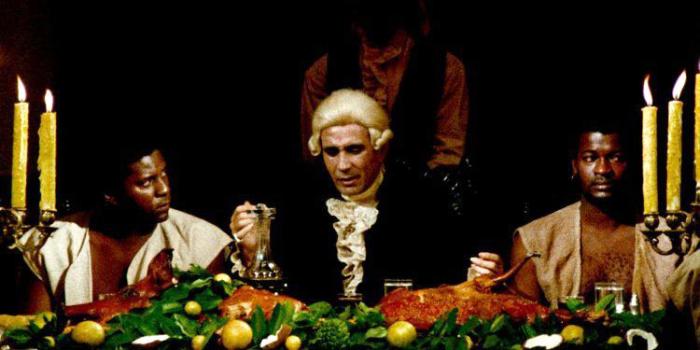
Titón would return to comedy several times, but his international renown dates from Memories of Underdevelopment (1968), a penetrating study of the early years of the Revolution in which the Cuban audience discovers itself breaking down the vocabulary of its own existence, in a modernist eclectic style which stands alongside European new wave cinema. But he was also drawn to history, and The Last Supper (1976) is a subtle, ironic anti-clerical fable set in a time just after the Haitian revolution of 1795. A plantation owner – brilliantly played by the exiled Chilean actor Nelson Villagra – invites twelve of his enslaved men to enact the Last Supper, echoing the beggars’ blasphemous parody of the Eucharist in Buñuel’s Viridiana. There follows an extended, sinuous Hegelian dialogue between enslaver and enslaved, and a masterclass in the deconstruction of ideological cant. An allegory of religious hypocrisy on a plantation, the film is a tour de force of black comedy.
In Up to a Point (1983), Alea returns to the present and turns his camera on his own milieu and the persistence of machismo. The film pays homage to Cuba’s first woman director, Sara Gómez, whom he had mentored and who died before being able to edit her first feature, One Way or Another (1975), which he completed together with fellow ICAIC founder member Julio García Espinosa. Like Gómez, Alea mixes fiction and documentary, juxtaposing a fictional love story with video footage of real dockworkers in a workers’ assembly, originally shot as part of research for the film, around which the fiction is then woven. A scriptwriter and a director are planning to make a film about machismo among Havana dockworkers, but the scriptwriter becomes embroiled in a fraught relationship with an unmarried mother who works there, forcefully played by Titón’s wife Mirta Ibarra. She delivers the moral of the film when she tells him that machismo is everywhere, not just among dockers, criticises the absence of women in a crew making a film about machismo, and warns him not to confuse her with the fictional character of his proposed movie.
Michael Chanan is a filmmaker and writer, author of ‘Cuban Cinema’, and Screen Cuba patron.
Twelve Chairs, Up to a Point and The Last Supper which will all be shown at Screen Cuba festival 15-28 March.

 SCREEN CUBA, 15-28 March 2026, LONDON & BEYOND